
 Canada
 USA
 Japan

Spey-Point vs Swayback: Two Traditional Folding Knives Compared

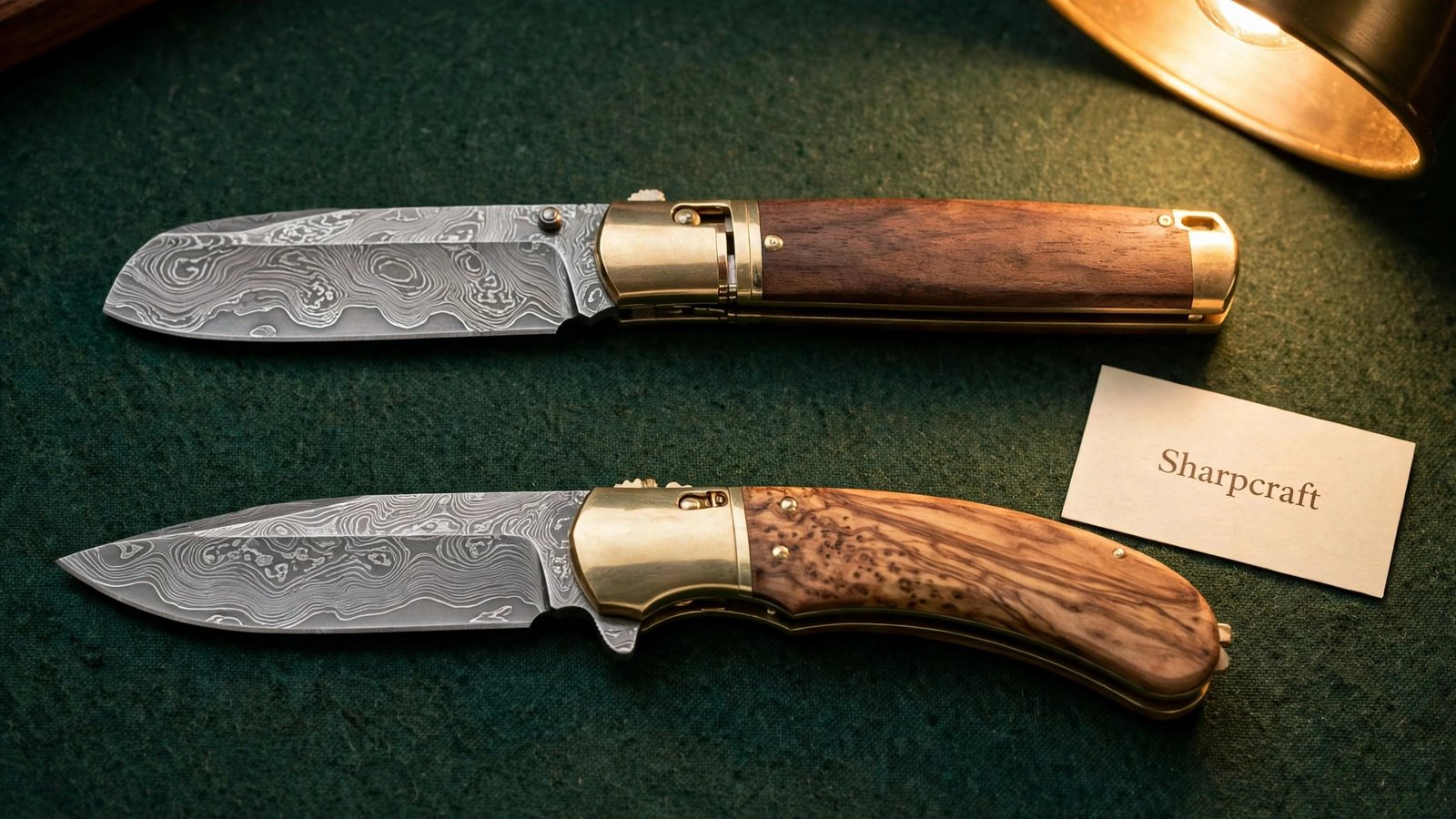
Spey-Point vs Swayback is a choice between two traditional folding knives that look similar on paper and feel very different in the hand. Both are handcrafted Sharpcraft Damascus folders with a 3.5-inch blade, a lock-back mechanism, and the same 67-layer steel. The difference is in the blade shape and the handle: the Spey-Point pairs a straight edge and a blunt, rounded tip with a walnut handle, while the Swayback pairs a clip-point blade with a curved olive wood handle. If you are choosing between them, the right knife is the one whose blade matches the cutting you do most.
Two Traditional Patterns, One Shared Foundation
Start with what the two knives share, because it is a lot. Each one is a hand-folded Damascus folder in 67 layers, hardened to 58-60 HRC, with an overall length of about 8 inches open and about 4.5 inches closed. Each one is a lock-back folder, so the blade locks open while you cut and folds away safely for the pocket. Each one arrives with a leather slip pouch and a pocket clip, plus a Sharpcraft care card. In other words, neither knife is a compromise on materials or construction. The choice is not about quality. It is about shape, and shape decides how a knife cuts, carries, and feels after a full day in your pocket.
The Spey-Point Blade: A Straight Edge for Controlled Cuts
The Sharpcraft Damascus Spey-Point Folding Knife 3.5 Inch is built around control. Its 3.5-inch straight edge slices cleanly through material without the point steering the cut, and its blunt, rounded tip means the point will not dig in or pierce by accident. That is the traditional spey-point idea: a working edge for controlled cutting, where a sharp point is a liability rather than a help. Think of opening boxes, cutting cord and strapping, preparing food at camp, or any job where you want the edge to do the work and the tip to stay out of trouble. The walnut handle adds to that steady character. Walnut is warm, smooth, and reassuring in the hand, and at about 140 g the knife carries easily without feeling insubstantial. If your cutting is mostly straight, deliberate, and close to your fingers, the Spey-Point is the natural pick.
The Swayback Blade: A Curved Clip-Point with Character
The Sharpcraft Damascus Swayback Folding Knife 3.5 Inch is the more expressive of the two. Its 3.5-inch clip-point blade has a finer, more defined point than the Spey-Point, so it is better for detailed work: starting a cut in the middle of a sheet, picking at a knot, or working around a curve. The frame is what gives the pattern its name. The back of the handle sweeps down in a gentle curve, so the knife sits low and comfortably in the palm and looks unmistakably traditional. Olive wood gives it a lighter, more figured appearance than the Spey-Point’s walnut, with grain that varies from knife to knife. At about 145 g it is only a few grams heavier than its stablemate, and it is just as slim in the pocket thanks to the same lock-back build and pocket clip. Choose the Swayback when you want a knife with a livelier point and a handle that stands out.
Handles in Hand: Walnut vs Olive Wood
Handles decide how a folding knife feels long after you stop noticing the blade. The Spey-Point’s walnut is dark, smooth, and understated, a classic handle wood that looks better the more you carry it. The Swayback’s olive wood is paler and more strongly grained, and the curved swayback frame fills the palm a little differently, with the sweep of the back guiding your grip forward onto the blade. Both handles are about 4.5 inches long, so the grip is a full four-finger hold on either knife, and both are shaped to work with the pocket clip for tip-down carry. There is no wrong answer here. Walnut suits a knife you want to disappear into your daily routine. Olive wood suits a knife you want to notice, and to be noticed, every time you take it out.
Everyday Carry: Which Knife Fits Your Day?
For everyday carry, the practical differences are small but real. Both knives open to about 8 inches, close to about 4.5 inches, and ride in a pocket on a clip with a leather slip pouch for storage. The Spey-Point has the edge, literally, for controlled, straight-line work: food preparation, cutting rope and packaging, and jobs around the house and garden where a blunt tip is safer. The Swayback has the edge for detail and versatility: its clip point starts cuts more easily and handles fiddly tasks better, while its curved handle is comfortable for longer sessions. Neither knife is a heavy-duty outdoor tool, and neither pretends to be. They are traditional folders for everyday cutting, made to be carried daily, used often, and kept sharp with a little routine care. Whichever you choose, dry the blade after use, oil it lightly now and then, and store it in its pouch rather than loose in a drawer.
The Verdict: Choose the Blade That Matches Your Cutting
So, Spey-Point vs Swayback: pick the Spey-Point if you want the most controlled, safest-tipped cutter of the two, with a straight edge and a warm walnut handle. Pick the Swayback if you want a finer point, a curved traditional frame, and the character of olive wood. Both give you the same handcrafted Damascus steel, the same lock-back strength, and the same pocket-friendly size, so you cannot go far wrong. If you still cannot decide, think about your most common cut. Straight, controlled cuts point to the Spey-Point. Detailed, point-first work points to the Swayback. Either way, you are carrying a traditional folder made to be used, not just admired.