
 Canada
 USA
 Japan


Katzbalger vs Jian: Two Short Swords Compared

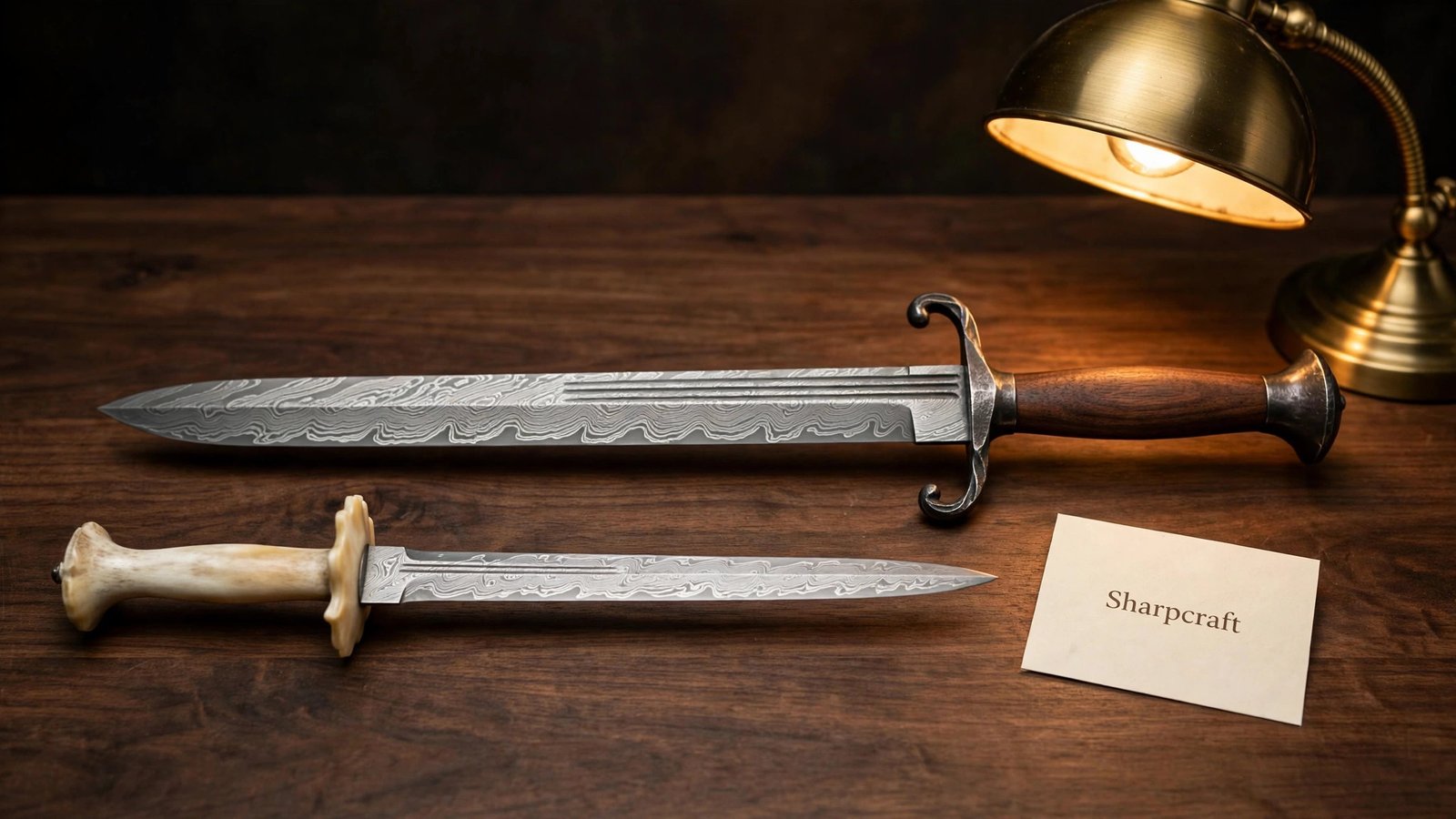
Two short swords, two sword traditions, and one very good reason to compare them side by side. In this katzbalger vs jian comparison, we look at a German landsknecht sword and a Chinese gentleman’s sword that share the same 12-inch blade length yet feel, look, and display completely differently. Both are short enough to handle comfortably and striking enough to anchor a collection, which is exactly why collectors keep asking which one to choose — or whether to own both.
What Each Sword Is
The katzbalger is the German landsknecht sword, the short, sturdy sidearm carried by the foot soldiers of Renaissance Germany. Its most recognisable feature is its S-shaped guard, a bold, curving quillon that gives the sword its swaggering, unmistakable silhouette. It was a working soldier’s weapon, made to be drawn quickly and used at close quarters, and that practical, no-nonsense character still shows in every line of the design.
The jian is the Chinese gentleman’s sword, a weapon with a very different reputation. Where the katzbalger is a soldier’s sword, the jian is a scholar’s and a nobleman’s sword, associated with refinement, discipline, and the ideals of the Chinese martial tradition. Its flared guard and round pommel give it a balanced, elegant profile that reads as graceful rather than aggressive. It is a sword made to be admired as much as wielded, and it has been a symbol of status and character in China for centuries.
Size Side by Side: Two 12-Inch Blades
Put the two swords next to each other and the first surprise is how closely they match on paper. Both carry a 12-inch blade, so neither sword dominates the other in length, and both sit comfortably in the short-sword class: long enough to feel like a real sword in the hand, short enough to display on a shelf, in a cabinet, or on a wall without needing a full-length mount.
The difference is in the details around that blade. The katzbalger’s S-shaped guard sweeps out on both sides and immediately draws the eye, while the jian’s flared guard is more restrained, widening gently before the blade begins. The katzbalger looks like a fighter; the jian looks like a gentleman. That contrast is the whole point of the comparison, and it is why the two swords work so well as a pair: they tell two different stories at the same scale.
What Each Sword Does Best
The katzbalger is at its best in a German medieval collection or a reenactment setting. Its landsknecht heritage makes it a natural fit alongside other European arms and armour, and its bold guard makes it instantly recognisable even to visitors who know little about swords. If your interest is German medieval history, or you take part in reenactment, the katzbalger is the sword that belongs in your hands.
The jian is at its best in a Chinese collection and on display. Its elegant lines and balanced proportions make it a centrepiece rather than a supporting piece, and it pairs naturally with other Chinese arms, art, and craftsmanship. If your interest is Chinese history and culture, or you want a display sword that rewards a closer look, the jian is the sword that will hold your attention.
Weight and Handling
On the scales, the two swords are almost identical. The katzbalger weighs about 470 g and the jian about 450 g, a difference of only 20 g that you would barely notice if you picked them up back to back. Both feel light, lively, and well balanced in the hand, and neither is tiring to hold for a display, a photograph, or a slow handling session.
Both swords are full tang, built the way a working short sword should be, with the blade steel running through the handle for strength and balance. Both are made in hand-folded Damascus steel, so each blade carries its own flowing pattern, and both come with a leather scabbard for storage and display. The handles are where they part company: the katzbalger has a warm walnut handle that suits its German, martial character, while the jian has a camel bone handle that suits its lighter, more refined Chinese character.
Which One Should You Buy?
If German medieval history is your passion, take the katzbalger. Its S-shaped guard, its landsknecht story, and its walnut handle make it the right sword for a European collection or a reenactment kit, and it will always look at home beside other German medieval pieces.
If Chinese history is your passion, take the jian. Its flared guard and round pommel, its camel bone handle, and its long association with the Chinese gentleman’s tradition make it the right sword for a Chinese collection or a display built around elegance and craftsmanship.
And if you cannot decide, that is the answer: buy both. Together, the katzbalger and the jian cover two sword traditions in one display, two continents, two philosophies of the sword, and two very different kinds of beauty — all at the same 12-inch scale. A pair like that tells a bigger story than either sword can tell on its own.
Sharpcraft’s Katzbalger and Jian Pair
Sharpcraft’s pair brings the two traditions together in matching hand-folded Damascus steel. The Sharpcraft Damascus Katzbalger Short Sword, with its 12-inch blade, S-shaped guard, and walnut handle, and the Sharpcraft Damascus Jian Short Sword, with its 12-inch blade, flared guard, round pommel, and camel bone handle, are both full tang and both supplied with a leather scabbard. You can see each sword up close on its own page.
Whichever you choose, you are choosing a short sword with a real history behind it. Choose the katzbalger for German medieval history, choose the jian for Chinese history, or choose both and let the two traditions share one display.