
 Canada
 USA
 Japan

Vegetable Cleaver or Heavy Cleaver?

A broad rectangular blade can look reassuringly substantial in a photograph. That silhouette alone does not tell you whether the knife is intended for vegetable preparation or a heavier workload. When shopping for a cleaver, the first decision is the kind of food preparation you need it to perform.
Similar outlines can serve different roles
WÜSTHOF describes the Chinese chef’s knife, also called a Chinese vegetable cleaver, as a kitchen tool especially suited to vegetable preparation. Its dedicated heavy cleaver is presented separately for demanding work, including bones. These manufacturer-specific examples show why the word “cleaver” is not a complete specification for every broad-bladed knife.
Do not transfer those capabilities to another product because its outline looks similar. A dramatic blade photograph, a dark finish or a thick-looking spine is not permission to use an unconfirmed knife on bones or frozen ingredients. Obtain the intended-use instructions for the exact model first.
Read Sharpcraft’s examples accurately
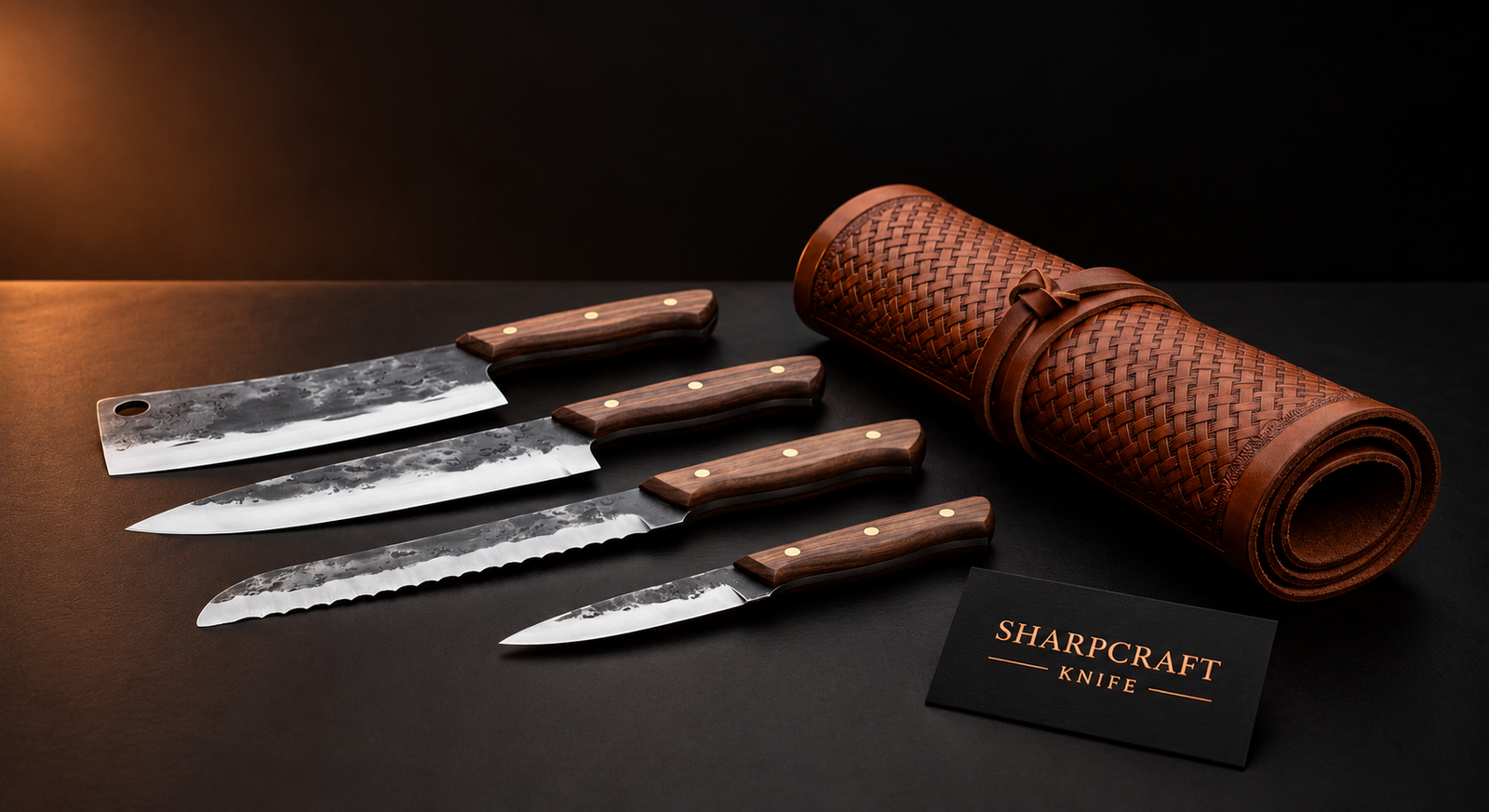
The Four-Piece Walnut Handle Kitchen Knife Set describes one photographed piece as having a broad cleaver profile. It does not assign that piece a bone-cutting capability. The Twisted Handle Cleaver with Brown Sheath identifies a twisted metal handle and visible blade profile, while asking customers to confirm specifications.
Use those references to discuss the shape and handle arrangement you prefer. Ask Sharpcraft which design, if any, is appropriate for your stated kitchen task. An honest answer about suitability is more useful than a general promise based on the product name.
Compare the practical fit
After confirming the intended role, request the blade length, blade height, thickness, overall weight and handle measurements for each candidate. Compare the working space on your board and the space in your storage system. A wide blade may require a different guard or storage slot from a narrow kitchen knife.
Our knife dimensions guide helps organise the measurements. Keep the same measurement questions for both candidates so that your comparison uses equivalent information.
Describe the job in ordinary language
An enquiry such as “I mainly prepare vegetables and want to compare these two broad blade profiles” gives the team a clear starting point. Name any demanding ingredient explicitly and request written confirmation of suitability. If the task is outside the design’s intended use, choose another tool.
Browse kitchen knives and cutters and review cutting board selection before completing your kitchen setup.
General references: WÜSTHOF Chinese chef’s knife guidance and its dedicated heavy cleaver example. These are educational comparisons, not Sharpcraft specifications.