
 Canada
 USA
 Japan

Damascus Pocket Knives for Everyday Carry: A Complete Guide

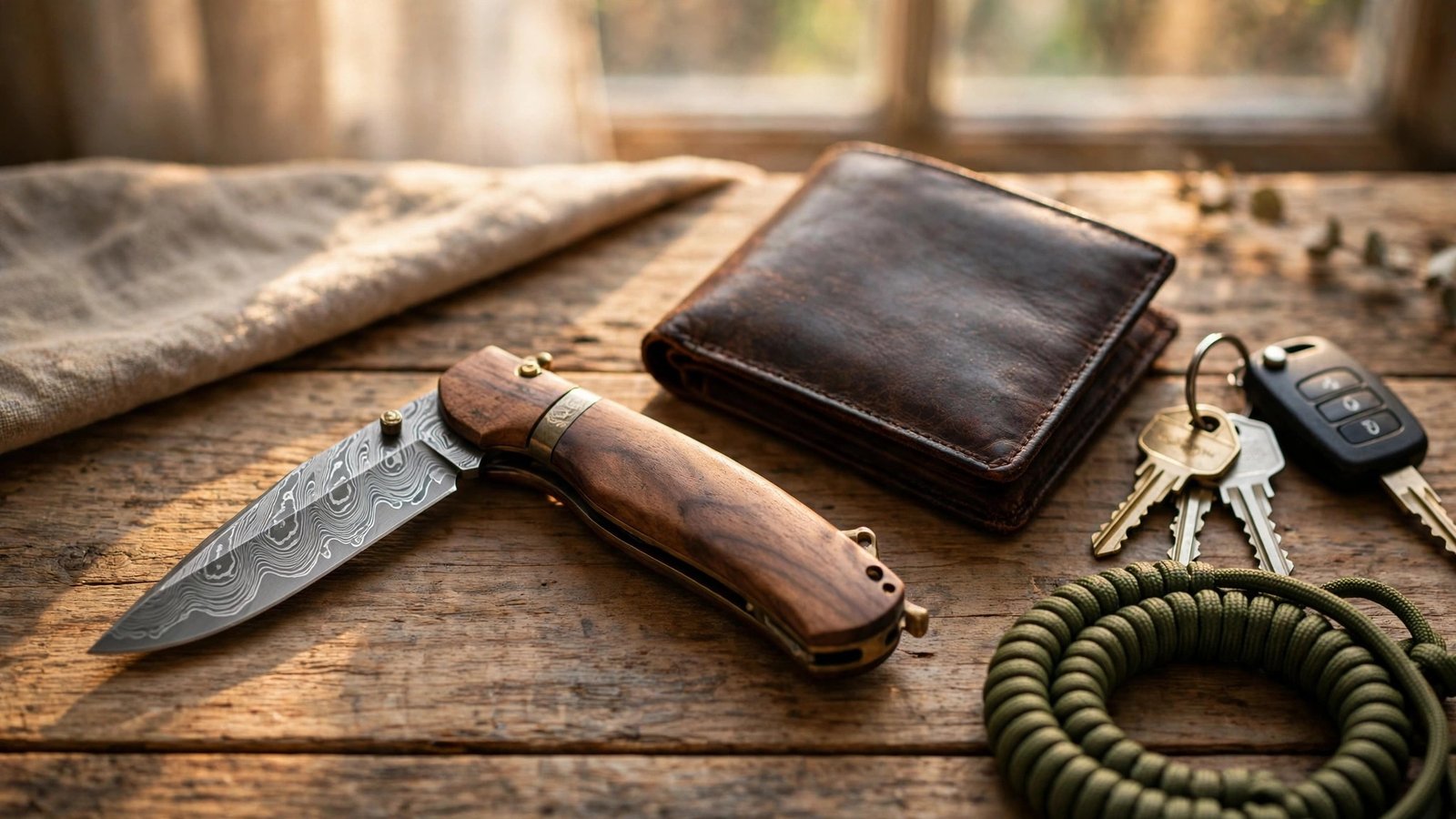
A good everyday carry knife is the one you actually have with you when you need it — opening a box, cutting cord, slicing an apple, trimming a loose thread. A Damascus pocket knife takes that everyday tool and makes it something worth carrying: a small, sharp blade in hand-folded Damascus steel, with a pattern no other knife shares.
This guide explains what a Damascus pocket knife is, why Damascus steel suits everyday carry, the blade shapes worth knowing, the handle materials you will meet, the law, and how to look after the knife once it is yours.
WHAT IS A DAMASCUS POCKET KNIFE?
A Damascus pocket knife is a small knife made to be carried every day, with a blade in Damascus steel. Damascus steel is made by folding and forge-welding layers of steel together, then grinding and finishing the blade so the layers show as a flowing wave pattern on the surface. Because the pattern comes from the folding itself, every blade looks slightly different — your knife is the only one with exactly that pattern.
Most Damascus pocket knives are folders: the blade folds into the handle, locks open while you use it, and rides in a pocket on a clip or in a slip pouch. Others are small fixed blades, like neck knives, carried in a sheath. Either way, the idea is the same — a compact blade, a handle that fills the hand, and a knife that is ready the moment you reach for it.
WHY DAMASCUS STEEL FOR EVERYDAY CARRY?
Damascus steel earns its place in a pocket knife for three reasons: edge, character and feel. A well-made Damascus blade takes a keen edge and holds it through daily cutting — cardboard, cord, food, packaging — and it is straightforward to bring back to sharp with a hone or a stone. It is a working steel, not a display piece.
Then there is the pattern. The layered wave on a Damascus blade is not printed or etched on; it is the steel itself. It deepens with use and care, and it makes a plain pocket tool feel personal. Two knives from the same maker can share a design and still never look alike.
Finally, Damascus steel suits the way a pocket knife is used. Everyday carry means the knife lives in a pocket, gets used for small jobs all day, and gets wiped and put away at night. A Damascus blade rewards that routine: a quick wipe, a dry handle, and it is ready again tomorrow.
BLADE SHAPES: DROP POINT, KARAMBIT AND NECK KNIFE
The blade shape decides what a pocket knife is good at. Three shapes cover most everyday carry needs.
Drop point. The drop point is the all-rounder. Its tip sits slightly below the line of the spine, giving a strong point and a long, curved cutting edge. It opens boxes, slices food, cuts cord and handles general work without drama. If you are buying your first Damascus pocket knife, a drop point is the safe, sensible choice.
Karambit. The karambit is the curved one: a hawkbill blade that sweeps down like a claw, with a finger ring at the end of the handle. It cuts on the pull, so it is natural for slicing rope, cord and packaging, and the ring locks the knife in the hand. It is a small fixed blade with a big personality, and it suits people who want something different from the usual folder. Check local rules before you carry one — karambits are restricted in some regions.
Neck knife. A neck knife is a small fixed blade carried in a sheath on a cord around the neck or on a belt. There is no folding mechanism, so there is nothing to fail, and the knife is always within reach. It is the knife you actually have with you: light enough to forget until you need it, and sharp enough to count on when you do.
HANDLE MATERIALS
The handle is what your hand meets every time you pick the knife up, so it matters as much as the blade. Damascus pocket knives come with natural handles that age well: rosewood and walnut, warm and smooth with a deep grain; olive wood, pale and close-grained; camel bone and stag horn, each with its own texture and colour; and micarta and buffalo horn, tough and grippy in the hand.
Natural handles change with use. Wood darkens, bone takes on a polish, and the handle becomes yours in a way a plastic handle never does. That is part of the appeal — and part of the care. Keep natural handles dry, wipe them after use, and they will last for years.
When you choose, think about the knife in your hand: does the handle fill your palm, does the grip feel secure when wet, and does the knife feel balanced rather than blade-heavy? A pocket knife should feel like an extension of your hand, not a lump in your pocket.
A NOTE ON THE LAW — CHECK LOCAL LAWS
Knife laws are local, and they vary a lot. Some places limit blade length, some restrict locking blades, some ban particular shapes — karambits among them — and some treat carrying a knife differently from owning one. The same knife that is perfectly legal in one town can be a problem in another.
Before you buy or carry a Damascus pocket knife, check the laws where you live and where you travel. If you are unsure, ask a local authority — this guide is not legal advice, and it cannot cover every rule in every place. Buy the knife you can carry with confidence, and carry it the way your local law allows.
HOW TO CARE FOR YOUR DAMASCUS POCKET KNIFE
A Damascus pocket knife is easy to care for, and a little care goes a long way. Hand wash the blade with warm water and mild soap after use, and dry it straight away — never leave it wet, and never put it in the dishwasher. A drop of oil on the blade now and then keeps the steel happy, and a dry sheath keeps it safe between uses.
Keep the edge keen with a hone or a fine stone, working at the angle the blade was sharpened to. Do not pry with the tip, do not cut on stone or glass, and do not use the knife as a screwdriver. Store it dry, in its sheath or slip pouch, out of damp pockets and toolboxes.
Cared for like this, a Damascus pocket knife does not wear out — it wears in. The pattern stays, the handle gains character, and the knife becomes the one you reach for first.
FIND YOUR EVERYDAY CARRY
If you are ready to choose, start with the Pocket Knives collection, where the folders and small fixed blades live. Two new arrivals show the range well: the Sharpcraft Damascus Karambit Knife, a curved hawkbill blade with a camel bone handle and finger ring, and the Sharpcraft Damascus Neck Knife EDC, a light 2.75-inch fixed blade in walnut with a leather neck sheath. Pick the shape that fits your hand and your day — then carry it, use it, and look after it.