
 Canada
 USA
 Japan


How to Choose a Damascus Axe

WHY A DAMASCUS AXE?
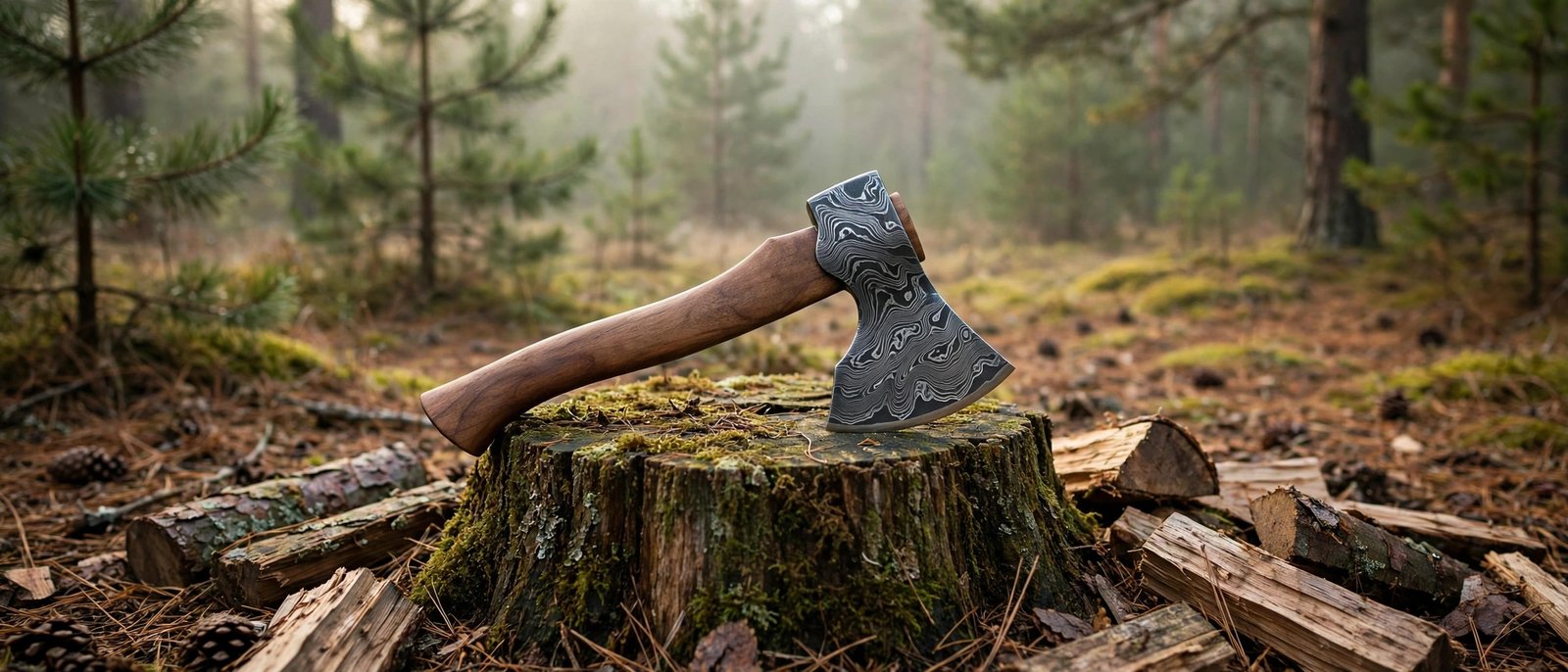
A Damascus axe is a working tool first and a showpiece second. The layered, hand-folded steel that makes a Damascus blade beautiful also makes an axe head tough: the alternating layers resist chipping, hold an edge through real chopping, and show a pattern no two axes share. If you want an axe you will actually swing — and still admire on the wall afterwards — Damascus is the right steel.
CAMP AXE, SPLITTING AXE OR DISPLAY PIECE? START WITH THE JOB
Before you compare steel or handles, decide what the axe has to do. A camp axe lives in a pack and does a bit of everything: limbing, kindling, light splitting. A splitting axe or maul is a heavier, single-purpose tool for firewood. A display or collector’s axe is judged on pattern, finish and balance rather than swing weight. Buy the axe for the job you will actually do most — a heavy splitter is miserable on a hiking trail, and a light camp hatchet will not split a winter’s worth of logs.
HEAD WEIGHT: THE NUMBER THAT MATTERS MOST
Head weight decides what an axe feels like in the hand. As a guide: a hatchet or camp axe head of around 1 to 1.5 lb is easy to carry and control one-handed; a full-size camp or felling axe head of 2 to 2.5 lb does serious chopping without wearing you out; a splitting axe head of 3 lb and up is for driving through rounds, not for carrying. Heavier is not better — it is just heavier. Match the weight to your strength and your task, and remember the handle adds weight too.
HANDLE LENGTH AND BALANCE
Handle length and head weight work together. A 14 to 16 inch handle suits a pack axe you swing one-handed. An 18 to 24 inch handle gives a camp axe two-handed control and real leverage. Full-size axes run 28 to 36 inches. Whatever the length, pick the axe up: it should balance just below the head, not feel head-heavy or handle-heavy. A well-balanced axe is safer, because it goes where you aim it.
THE STEEL: WHAT TO LOOK FOR
A good Damascus axe head is hand-folded steel, hardened to around 58–60 HRC — hard enough to hold an edge, tough enough not to chip when it meets a knot. Ask how the head was made: a forged head, not a cast one, and a full, solid eye where the handle seats. The pattern should run through the steel, not sit on the surface like a print — on a real Damascus head the pattern is in the metal itself, and it shows on the edge as well as the face.
EDGE GRIND: THIN FOR CUTTING, THICK FOR SPLITTING
The grind is the shape of the cutting edge, and it follows the job. A thin, keen convex grind bites deep and is ideal for a camp or felling axe. A thicker, wedge-shaped grind pushes wood apart and suits a splitting axe. If you plan to do both, choose a middle-ground convex edge and keep it sharp — a sharp axe is a safe axe, because it does the work instead of glancing off.
HANDLE MATERIAL AND FIT
A handle should be straight-grained hardwood — hickory is the classic choice, with walnut and other dense hardwoods also used. Check the grain runs along the handle, not across it, and that the head is seated tight on a properly wedged eye with no gaps or wobble. The grip should fill your hand without forcing your fingers open. If the handle ever loosens, stop using the axe until it is re-seated — a loose head is the most common cause of axe accidents.
SHEATH, CARE AND STORAGE
Every axe you carry needs a sheath or head cover — for the edge, and for everyone around you. After use, wipe the head dry, oil it lightly, and store it somewhere dry; Damascus steel is carbon steel at heart, and it will spot if left damp. Keep the edge touched up with a file and stone rather than letting it go dull, and never store an axe head-down in the dirt or leaning against a damp wall.
OUR DAMASCUS AXES
Our Damascus axes are hand-forged in the same way as our knives: hand-folded Damascus steel, full tang-style solid construction, hardwood handles and a leather sheath included. Browse our Damascus axes to find your camp, splitting or display piece — and if you want something made to your own measurements, ask us about a custom order.
QUICK CHECKLIST BEFORE YOU BUY
- Decide the job: camp, splitting, felling or display.
- Pick a head weight you can swing all day, not just once.
- Check the balance point sits just below the head.
- Confirm forged, hand-folded Damascus steel at 58–60 HRC.
- Match the grind to the job: thin for cutting, wedge for splitting.
- Inspect the handle grain, the eye fit and the sheath.