
 Canada
 USA
 Japan

Kiritsuke vs Gyuto: Two Japanese Chef Knives Compared

Two Japanese chef knives, one kitchen, and a question every keen cook asks sooner or later: kiritsuke or gyuto? They look like cousins at first glance — long, slim, elegant blades with beautiful Damascus patterns — but they cut in different ways, and the difference matters the moment the blade meets the board.
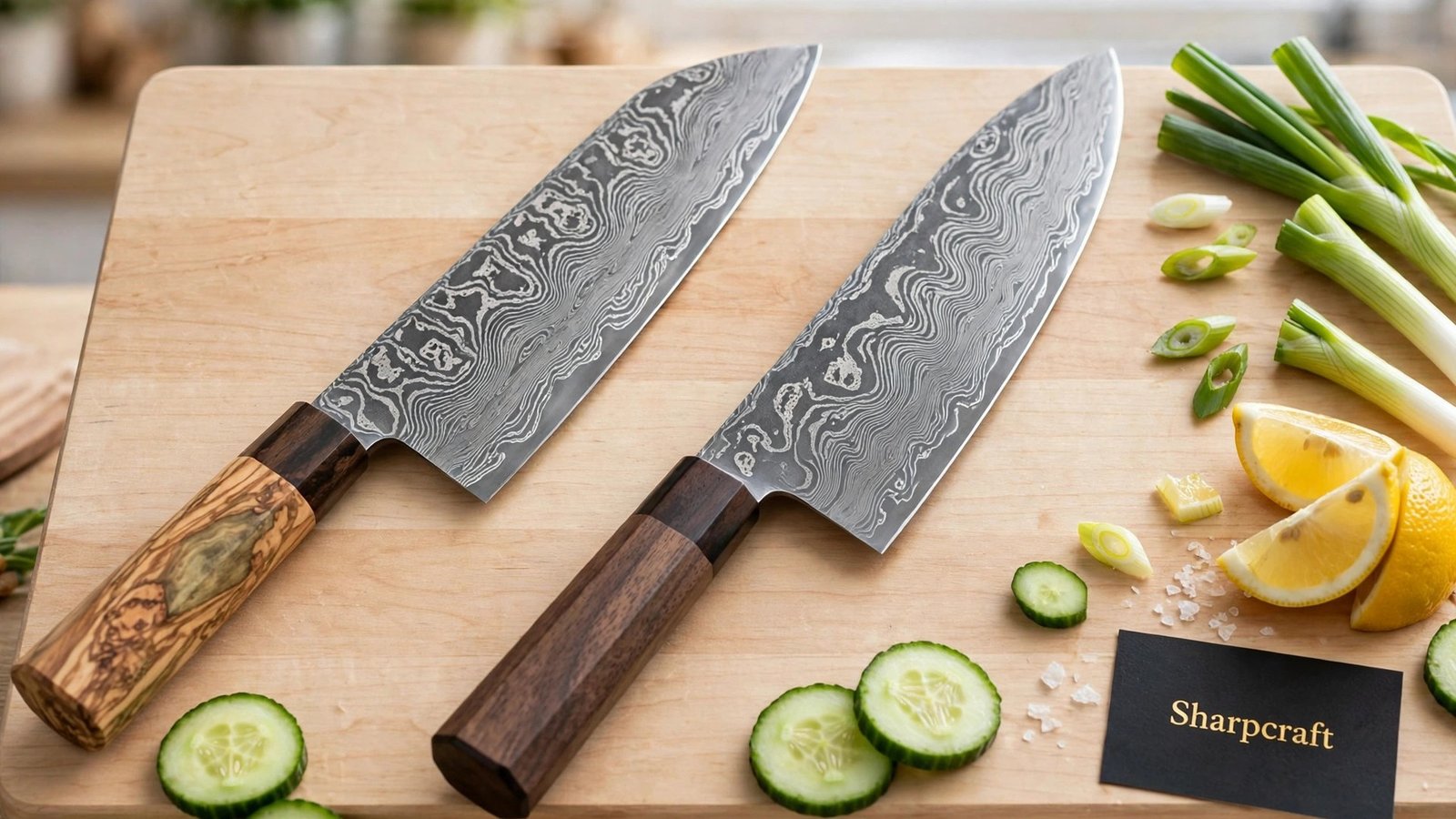
Both knives below are Sharpcraft’s own handcrafted versions: hand-folded Damascus steel, each pattern unique, 58–60 HRC, full tang, and — important for most home cooks — double-bevel edges, so either hand can use them.
What Each Knife Is
The gyuto is the all-round Japanese chef knife. Think of it as Japan’s answer to the Western chef knife: a versatile blade that handles almost everything in a home kitchen, from slicing an onion to breaking down a chicken. It is the knife most cooks reach for first, and the one most Japanese kitchens keep closest to hand.
The kiritsuke is the master chef’s knife. In a traditional Japanese kitchen it was the knife of the head chef — a long blade with a flat edge and a sharply angled tip, built for precise, deliberate work. It looks dramatic on the board, and it rewards a cook who likes control.
Blade Shape Side by Side
Put them next to each other and the difference is easy to see. The gyuto has a gently curved belly: the edge sweeps up toward the tip, so the knife rocks naturally when you chop. That curve is what makes the gyuto so forgiving — you can rock through herbs, glide through an onion, and slice a tomato without thinking about technique.
The kiritsuke has a long, almost completely flat edge and an angled tip — the K-tip — where the spine slopes down to meet the edge in a sharp point. The flat edge stays in full contact with the board, so every millimetre of the blade works on a push cut. The angled tip is made for detail work: scoring, trimming, and precise cuts where a rounded tip would get in the way.
What that means on the board: the gyuto wants to rock, the kiritsuke wants to push. Neither is wrong — they are two answers to the same job.
What Each Does Best
The gyuto is the everyday workhorse. Rocking cuts through herbs, dicing onions, slicing meat, portioning fish — it does all of it well, and it asks little of the cook. If your kitchen runs on speed and variety, the gyuto earns its place every single day.
The kiritsuke shines at precise slicing. Vegetables cut in clean, even slices because the flat edge meets the board along its whole length. Fish slices thin and true. The angled tip handles fine trimming and scoring with a control a curved tip cannot match. It is the knife for the cook who enjoys the cutting itself — slow, exact, deliberate.
One honest note: the kiritsuke’s flat edge does not rock. If your cutting style is all rocking cuts, the gyuto will feel more natural. And the kiritsuke’s fine tip is a precision tool, not a pry bar — use it for cutting, not for levering.
Sharpening and Care
Both Sharpcraft versions are double-bevel, ground evenly on both sides. That matters for two reasons: either hand can use them comfortably, and a normal whetstone keeps the edge — no special single-bevel technique needed.
Care is the same for both: hand wash after use, dry straight away, and oil the blade lightly before storing it. Never put a handcrafted Damascus knife in the dishwasher, and never leave it wet on the board. A sharp knife is a safe knife — a dull edge slips, a sharp edge cuts where you aim it.
Which One Should You Buy?
If you are buying one knife only, take the gyuto. It does more jobs, forgives more technique, and covers the whole kitchen on its own. It is the right first Japanese knife for almost every cook.
If you already have a good all-round chef knife and want a precise slicer — or you simply love the look and feel of the kiritsuke’s flat edge and angled tip — take the kiritsuke. It is the second Japanese knife that changes how you cut vegetables and fish.
And if you want the pair, they cover the whole kitchen together: the gyuto for everyday speed, the kiritsuke for precise slicing. That is exactly why Sharpcraft makes them as a matching pair.
Sharpcraft’s Pair
Sharpcraft’s Gyuto 8-inch and the new Kiritsuke 8-inch share the same handcraft: hand-folded Damascus steel with a pattern unique to each blade, 58–60 HRC, full tang, and a hand-stitched leather sheath. The gyuto wears walnut; the kiritsuke wears olive wood. Both are made to order — two Japanese knives, one kitchen, no compromise on either.