
 Canada
 USA
 Japan

Spear-Point vs Trailing-Point: Two Folding Knives Compared

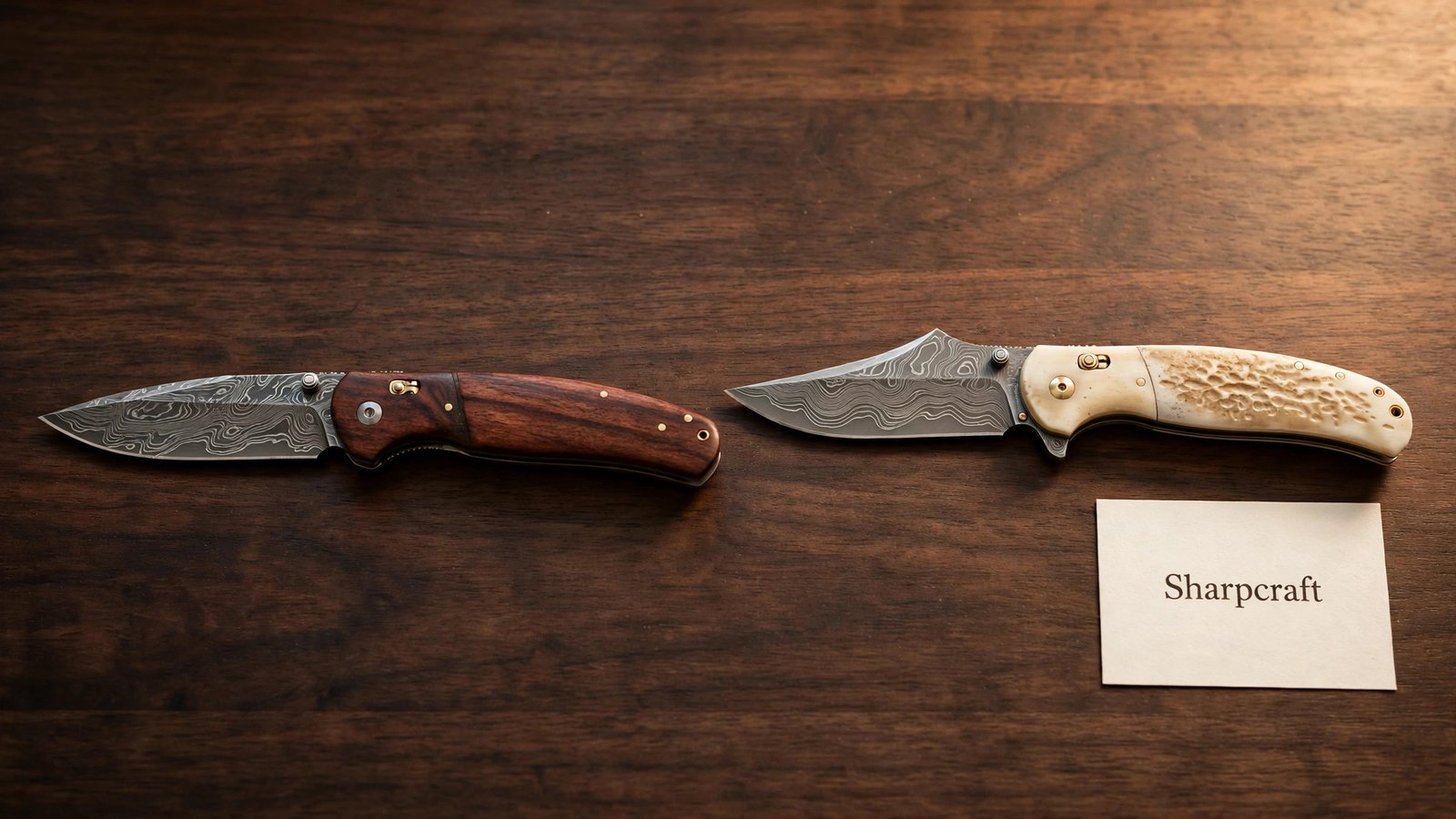
Two new folding knives have joined the Sharpcraft range, and at first glance they look like the same knife twice. Both are 3.5-inch Damascus folders with a lock-back action, a leather slip pouch and a pocket clip, and both cost $189. The difference is at the tip: one carries a symmetrical spear-point blade, the other an upswept trailing-point blade.
So, spear point vs trailing point — which blade shape earns a place in your pocket? This comparison looks at both knives honestly: what each blade shape does well, where it is less handy, and which one fits the way you actually use a folding knife.
Two blades, one folder
Before the blades, the shared ground. Both folders are built on the same pattern: a hand-folded Damascus blade in 67 layers, hardened to 58–60 HRC, with a lock-back action that closes flat for the pocket. Both measure about 8 inches open and about 4.5 inches closed, with a 3.5-inch blade, and both arrive with a leather slip pouch and a pocket clip. The spear-point weighs about 140 g; the trailing-point about 135 g. The handles are where the two knives first part company in the hand: warm rosewood on the spear-point, pale camel bone on the trailing-point. Both are natural materials, so the colour and figure of each handle will vary a little from knife to knife. What you are choosing between, then, is not quality or size. It is the shape of the tip — and the kind of cutting you do most.
The spear-point: a centred tip that pierces cleanly
The spear-point blade is symmetrical. Its two edges rise evenly to a point that sits on the centreline of the blade, so both sides of the steel support the tip. That centred point is the spear-point’s great strength: it starts a cut exactly where you put it, and it pierces cleanly without the tip wandering or flexing to one side. Push the point into card, leather or packaging and it goes in straight, with the edge behind it ready to open the cut. Because both edges are sharpened, the blade also slices on either side, which makes it a forgiving shape for everyday jobs — opening boxes, cutting cord and trimming tape. The trade-off is that the point is a working point rather than a needle point. It is strong and honest, but it is not made for the very finest detail work, where a slimmer, more delicate tip can reach further into a tight spot.
The Sharpcraft Damascus Spear-Point Folding Knife 3.5 Inch costs $189 and is the spear-point of the pair, with its rosewood handle and centred, symmetrical blade.
The trailing-point: an upswept tip for fine work
The trailing-point blade sweeps upward. Its spine rises toward the tip, leaving a long, gently curved cutting edge and a fine point that sits high on the blade. That fine tip is the trailing-point’s advantage: it is made for precise, delicate work — starting a small cut, picking at a thread, tracing a line, or working in a tight corner where a broader point cannot reach. The long curved edge also gives a longer slicing stroke, which suits draw cuts through card, cord and softer materials. The trade is strength at the very tip. A fine, upswept point is not a pry bar and not a piercing tool for tough material; used hard against resistance it is the more vulnerable of the two tips, and it asks to be used with a lighter touch.
The Sharpcraft Damascus Trailing-Point Folding Knife 3.5 Inch costs $189 and is the trailing-point of the pair, with its camel bone handle and upswept, fine-tipped blade.
Slicing and everyday cutting
For ordinary slicing the two knives are closer than their tips suggest. Both blades are the same length, the same steel and the same hardness, so both take and hold an edge in the same way, and both handle the everyday list — tape, card, cord, string, packaging and light food preparation — without fuss. The difference shows in how the cut feels. The spear-point cuts with a straight, even push and starts exactly where the centred point lands, which makes it the easier knife to aim. The trailing-point rewards a drawing stroke, letting its curved edge do the work over a longer cut. Neither knife is a kitchen knife or a heavy-duty tool, and neither is meant for prying, batoning or cutting hard materials. Used as folding knives — opened, used, wiped and closed — both will do a full day’s ordinary work.
Carrying them every day
A folding knife earns its place by being there when you need it, and both of these are easy to carry. At about 8 inches open and 4.5 inches closed, with a slim lock-back that closes flat, either knife slips into a pocket with its clip or rides in the leather slip pouch that comes with it. The weights are near-identical — about 140 g for the spear-point, about 135 g for the trailing-point — so neither drags a pocket down. The choice of handle is a matter of taste and of what you like to look at: the deep, warm grain of rosewood against the pale, smooth finish of camel bone.
Which one should you choose?
Choose the spear-point if piercing and a centred, dependable tip matter most to you — if you want a knife that starts a cut exactly where you put it and handles the ordinary jobs with either edge. Choose the trailing-point if your work is finer: detail cuts, precise starts, and long slicing strokes where a delicate tip and a curved edge earn their keep. If you mostly open boxes, cut cord and carry a knife for the odd job, either will serve you well — and honestly, the difference between them is smaller than the difference between either of them and a knife that stays at home. In the end, spear point vs trailing point is a choice of tip, not of quality: both are the same price, the same steel and the same size; the decision is simply which tip suits your hand. Whichever you choose, use the tip for cutting, keep the edge clean and dry, and let the lock-back do its job.