
 Canada
 USA
 Japan

Damascus Steel vs Stainless Steel: Which Knife Is Right for You?

Choosing between Damascus steel and stainless steel is one of the first decisions any knife buyer faces, and it is also one of the most misunderstood. Both steels can make an excellent knife, but they do it in different ways: one trades a little extra care for a wavy pattern and a keen, characterful edge, while the other trades a little of that character for easy, forgiving maintenance. In this guide to damascus steel vs stainless steel, we compare how the two steels are made, how they hold an edge, how they behave around water and food, and which one fits the way you actually cook, hunt or carry a knife.
There is no single winner. A Damascus chef knife can be the most satisfying knife in a home kitchen, and a stainless knife can be the right call for a boat, a busy restaurant line or a drawer that is not always dried properly.
What Is Damascus Steel?
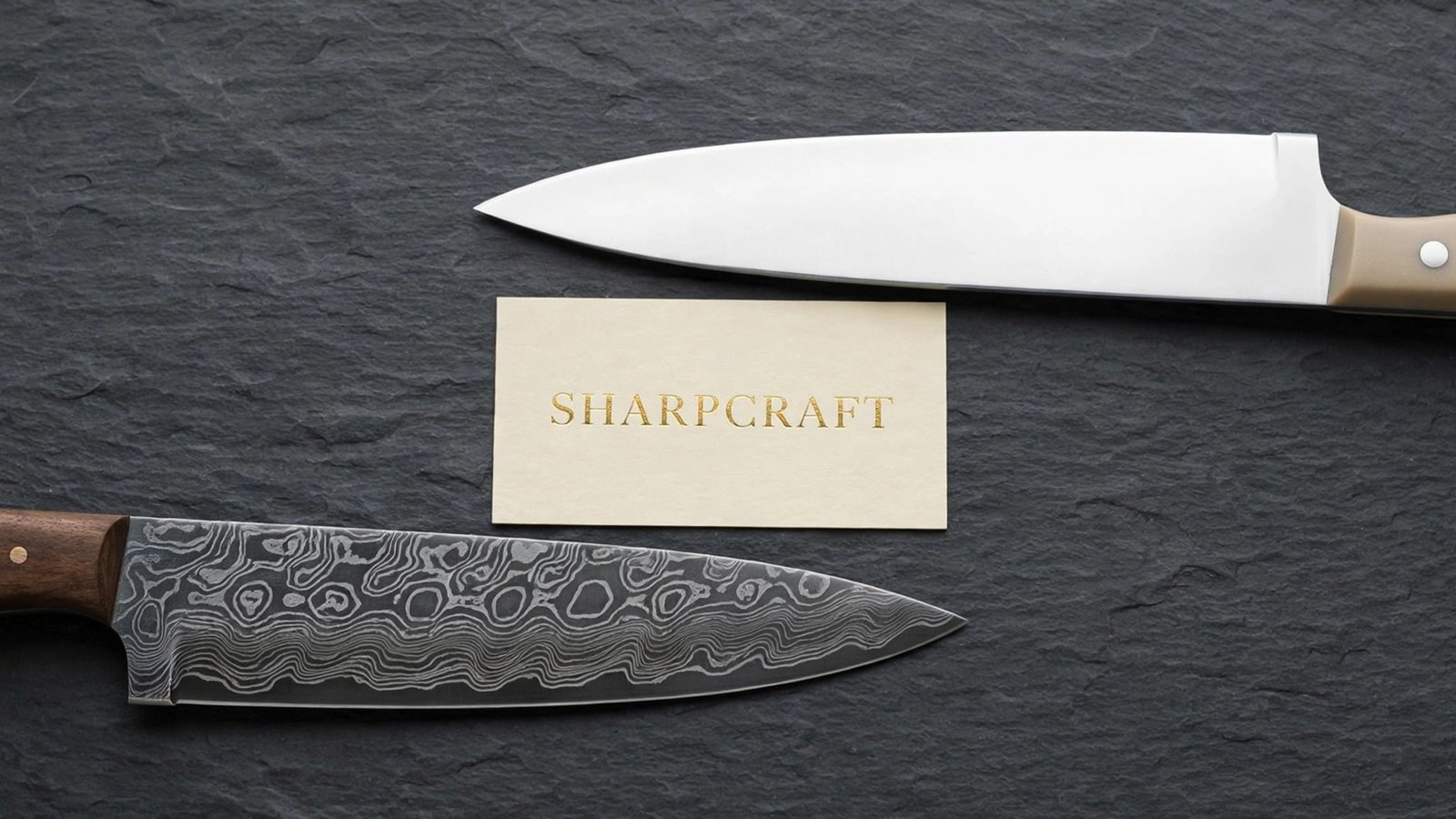
Damascus steel is made by folding and forge-welding layers of steel together, then grinding the blade so the layers show as a flowing, water-like pattern on the surface. Sharpcraft Damascus is hand-folded in 67 layers, which is why no two blades ever look exactly alike: the pattern is a record of the folding, not a print or an etch. The steel used in our Damascus knives is hardened to 58–60 HRC, a level that holds a fine edge well while still being practical to sharpen. It is a working steel first and a beautiful one second.
What Is Stainless Steel?
Stainless steel is a family of steels with enough chromium — usually at least 10.5 percent — to form a thin, invisible layer of chromium oxide on the surface. That layer is what makes stainless steel stainless: when it is scratched, it reforms in air, so the blade resists rust and staining far better than a plain carbon or layered Damascus blade. Most modern stainless kitchen knives are hardened to around 56–58 HRC. The result is a tough, practical blade that shrugs off a wet sink, acidic food and a dishwasher cycle far more readily than Damascus.
How Each Steel Is Made
The difference starts at the forge. A Damascus billet is built up layer by layer, folded, welded and folded again until dozens of layers are locked together; the smith then shapes the blade, grinds the bevels and etches the surface lightly so the pattern stands out. Every fold is a chance for variation, which is why the wave pattern differs from knife to knife. A stainless blade, by contrast, is usually cut or forged from a single sheet or bar of stainless steel, heat-treated, ground and finished. The process is more repeatable, which is why stainless knives are easier to make in large numbers at a consistent price.
Edge, Sharpness and Sharpening
In everyday use, both steels can be made very sharp, and both will cut well when they are properly sharpened. Damascus at 58–60 HRC generally takes a very fine edge and holds it a little longer in slicing, because the harder steel resists the tiny rolling and dulling that comes with cutting board contact. Stainless steel is usually a touch softer, so it may need honing a little more often, but it is also more forgiving: it is less likely to chip if it meets a bone, a frozen joint or a careless twist on the board. Sharpening is straightforward for both — a whetstone, a ceramic rod or a professional service all work — but Damascus rewards a lighter touch and a consistent angle, because a hard, thin edge can chip if it is ground too aggressively.
Rust, Stains and Everyday Care
This is where the two steels part company most clearly. Stainless steel is the low-maintenance choice: rinse it, wipe it dry, put it away, and it will usually forgive a night left in the sink. Damascus needs a little more attention. After use, wash the blade by hand, dry it fully — including around the handle and the sheath — and store it dry, ideally with a light coat of food-safe oil if you will not use it for a while. Acidic foods such as tomatoes, citrus and onions can leave marks on Damascus if they are left sitting on the blade, and a leather sheath should be kept dry, because a damp sheath will hold moisture against the steel. If you know you will not do it, stainless steel is the honest choice.
Looks, Feel and Character
Look at the two steels side by side and the difference is immediate. Damascus has a flowing wave pattern that moves as the light moves, and a handle in olive wood, walnut or stag horn makes each knife look like a one-off — because, in pattern at least, it is. Stainless steel is cleaner and quieter: a bright, even finish that looks the same on every knife and suits a modern kitchen. Choose Damascus for character, stainless for a tool that disappears into the job.
Which Knife for Which Job?
In the kitchen, the choice often comes down to how you cook. A Damascus bunka is a good example of what Damascus does best: its 6.5-inch reverse-tip blade is nimble for detail work and broad enough for a full board of prep, and the olive wood handle makes it a knife you reach for. For big meat, a Damascus cimeter takes long, even draw cuts through brisket and primals that a short chef knife cannot match. In a busy, shared kitchen, a stainless chef knife will be more forgiving of a wet drawer, and it will still slice well.
Outside, the same logic applies, with weather added in. A Damascus hunting knife with a walnut handle is a strong field companion for dressing and skinning, and a Damascus tracker is built to be the one knife you carry when you need to chop, baton and notch as well as cut. Both need to be dried and oiled after a wet day, which is easy at camp if it becomes part of the routine. If you expect the knife to live in a wet pack, a boat or a tackle box, stainless steel will tolerate that neglect better. The deciding question is not how tough the steel is, but how reliably you will dry it.
Damascus vs Stainless at a Glance
- Edge retention: Damascus (58–60 HRC) holds a fine edge a little longer; stainless needs honing a little more often.
- Rust resistance: stainless wins clearly; Damascus needs hand washing and drying.
- Sharpening: both sharpen well; Damascus rewards a light touch, stainless forgives a heavy one.
- Looks: Damascus is patterned and individual; stainless is clean and uniform.
- Care: stainless is low maintenance; Damascus asks for a few minutes after use.
How to Choose
Ask yourself three questions. What will you cut most — fine kitchen prep, big meat, game in the field or everyday carry? Will you dry the blade after use, every time? And does the pattern matter to you? If you answered fine prep or field work, yes to drying, and yes to the pattern, Damascus is probably your knife. If you answered a busy shared kitchen and maybe to drying, stainless steel will make you happier. If you are still torn, browse our Damascus knives collection — the right answer often becomes obvious when you see a real blade.
Damascus steel vs stainless steel is not a contest with a winner, but a choice between two honest trade-offs: character and edge retention against easy care and rust resistance. Choose the steel that fits the way you will actually use and care for the knife, and either one will serve you well for years. If you want a blade with a pattern no one else owns, start with Damascus; if you want a blade you never have to think about, start with stainless. Either way, keep it sharp, keep it dry, and it will keep working.