
 Canada
 USA
 Japan

How to Choose a Damascus Hunting Knife

A hunting knife is the one tool you reach for again and again in the field. It dresses game, cuts cord, prepares food at camp, and handles a dozen small jobs you never planned for. The wrong knife makes every one of those jobs harder, and a knife that fails when your hands are cold and the light is fading is worse than no knife at all. This guide covers what actually matters when you choose a Damascus hunting knife, so you can buy once and buy right.
Why the Right Hunting Knife Matters
A hunting knife is not a decoration, and it is not a do-everything survival blade either. It is a working tool that has to cut cleanly, stay sharp through a full day, and stay safe in your hand when it is wet with blood, rain, or cold. A blade that is too long gets in the way; a blade that is too short cannot reach through a chest cavity. Get the choices below right — shape, length, steel, tang, handle, sheath, and balance — and the knife becomes the tool you trust most.
Blade Shape: Drop Point vs. Clip Point vs. Trailing Point
Three blade shapes cover almost every hunting knife: the drop point, the clip point, and the trailing point. Each cuts differently, and the difference matters most when you are dressing game.
The drop point is the safest all-rounder, and the shape we recommend for most hunters. The spine slopes gently to the tip, so the point sits low and in line with the handle. The tip is strong, it is hard to puncture a gut by accident, and the broad belly slices cleanly. For field dressing, skinning, and camp work, a drop point does everything well.
The clip point has part of the spine clipped away, leaving a finer, sharper tip. It is excellent for detail work, but the tip is thinner and easier to break, and it can puncture where you do not want it to.
The trailing point sweeps the tip upward, giving a long, curved edge that is wonderful for skinning. But the upswept tip is delicate and the easiest of the three to snap.
Blade Length: The 4–5 Inch Sweet Spot
For field work, the sweet spot is a 4–5 inch blade — long enough to dress a deer cleanly, short enough to control with one hand when you are working inside a carcass or cutting close to your fingers, and light enough to carry all day.
Longer blades earn their place when the game gets bigger or the knife has to do camp work too. A 9-inch blade like our Damascus Tracker Knife 9.5-inch will baton wood, clear brush, and handle big game, but it is more knife than a whitetail hunt needs. Shorter blades, around 4 inches, suit small game and birds, and a compact knife like our Damascus Bushcraft Knife 4.5-inch is easy to carry and quick in the hand. If you hunt mostly deer and medium game, start at 4–5 inches. For elk or moose, or one knife for hunt and camp, go longer.
Steel and Hardness: Hand-Folded Damascus
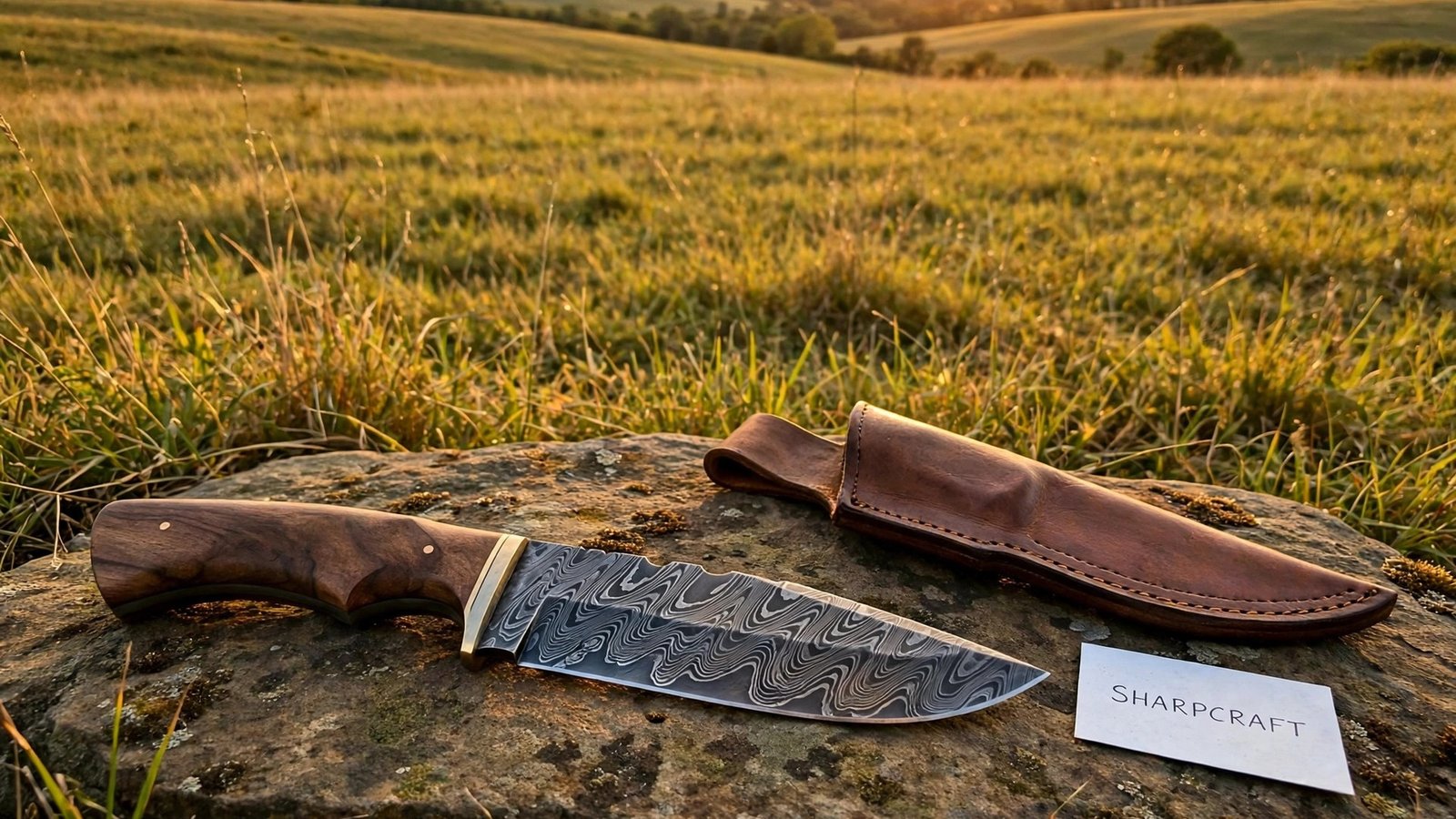
A Sharpcraft hunting knife is made from hand-folded Damascus steel. Layers of steel are folded and forged together by hand until the blade shows the flowing, water-like pattern that gives Damascus its name. The pattern runs through the steel, and no two blades are alike.
We harden our hunting blades to a working hardness of 58–60 HRC — hard enough to hold a fine edge through a long day of field dressing, and not so hard that the edge chips when it meets bone. A softer blade dulls fast; a harder blade can be brittle. At 58–60 HRC, a Damascus hunting knife holds its edge and still takes a keen edge again with a stone or a steel.
One thing to know before you buy: our Damascus is carbon steel, not stainless steel. Carbon steel takes a sharper edge and holds it longer, but it needs care. Hand-wash it after use, dry it right away, and never leave it wet in its sheath. If you are weighing the two steels, read our guide to Damascus Steel vs Stainless Steel.
Full Tang and Handle
Strength starts with the tang. A full tang knife is made from one piece of steel that runs the full length of the handle, with the handle scales riveted to it on either side. There is no joint to loosen and no weak point at the grip. Every Sharpcraft hunting knife is full tang.
The handle matters as much as the blade, because it is the part your hand actually meets. We fit ours in walnut, olive wood, rosewood, and camel bone — natural materials that look better the more you use them and warm to your hand in cold weather. What matters most is grip when it is wet or cold: the handle should fill your hand, keep your fingers off the edge, and not turn slick when wet.
Sheath: A Fitted Leather Sheath
A hunting knife is only as safe as its sheath. A fitted leather sheath holds the blade snugly, covers the edge completely, and lets you draw and return the knife one-handed. A loose sheath lets the knife rattle, dulls the edge, and can let the blade slip out when you bend over or climb. Look for a sheath made for your exact knife, not a generic pouch. Every Sharpcraft hunting knife ships with a fitted leather sheath made for that blade.
Weight and Balance
Pick the knife up and hold it the way you will use it. A hunting knife should feel balanced just ahead of the handle, with the blade doing the work and the handle staying steady in your palm. A blade-heavy knife tires your wrist; a handle-heavy knife feels clumsy at the tip. If a knife feels wrong in the shop, it will feel worse after four hours in the field.
Care After the Hunt
Damascus is carbon steel, so the ten minutes after the hunt matter as much as the knife itself. Clean the blade as soon as you are done — warm water, a little soap, and a soft cloth. Dry it immediately and completely, including around the guard. Then wipe the blade with a light coat of food-safe oil and store it dry, out of the sheath, where air can reach it. Never put a wet knife away in its leather sheath: leather holds moisture against the steel, and Damascus will spot and rust if stored wet.
What to Check Before You Buy
Before you spend your money, run through this checklist:
- Blade shape: a drop point if this is your first or only hunting knife.
- Blade length: 4–5 inches for deer and field work; longer for big game or camp use.
- Steel: hand-folded Damascus, hardened to 58–60 HRC, with an edge that holds.
- Tang: full tang, with the steel running the whole length of the handle.
- Handle: walnut, olive wood, rosewood, or camel bone — and a grip that stays secure when wet or cold.
- Sheath: a fitted leather sheath made for that exact knife.
- Weight and balance: balanced just ahead of the handle, comfortable for a full day.
- The maker: a company that stands behind the knife. Our knives are handcrafted in Pakistan and backed by our USA office at 146 West St, Bloomsburg, PA 17815 — call +92 311 7689774 to talk through a choice.
Our 2026 catalog has 138 designs across 9 collections — browse the whole range in our shop. Start with a proven field knife like our Damascus Hunting Knife 5-inch, and you will have a knife that does the work and lasts.