
 Canada
 USA
 Japan


How to Store Your Damascus Knives

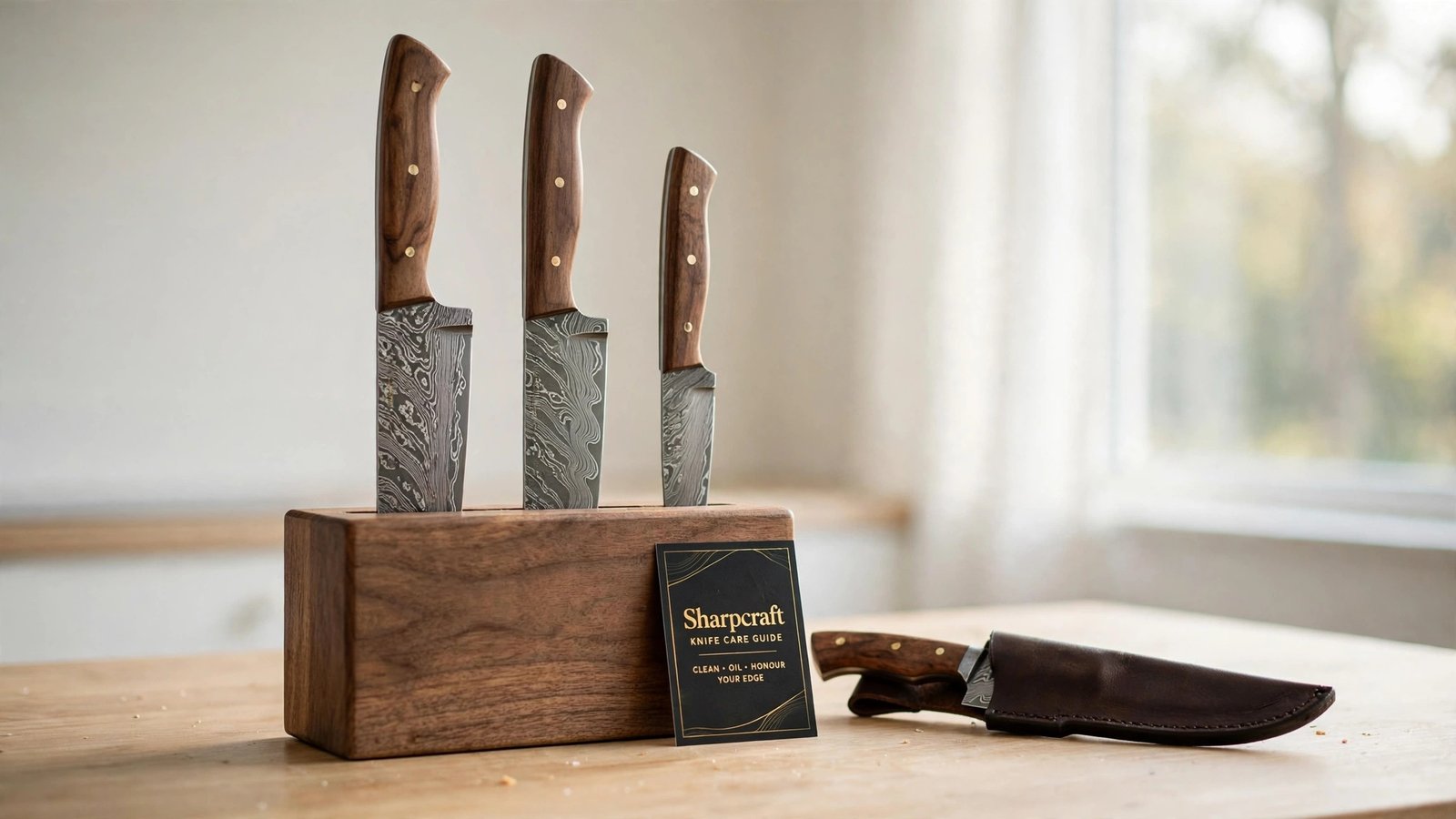
A good Damascus knife is a working tool and a piece of craftsmanship in one, and learning how to store Damascus knives properly is what decides whether that blade still looks and cuts like new in five years, or starts to spot, dull and rust in a few months. Hand-folded Damascus is made from many thin layers of carbon steel, folded and forged into the wave pattern that makes each blade unique. That layered carbon steel is also the reason storage matters so much: unlike stainless steel, it rusts when it stays damp. A wet blade in a damp drawer, or a knife left sitting in a wet sheath, is an open invitation to rust. The good news is that proper storage is simple, takes less than a minute after each use, and costs almost nothing. This guide covers why storage matters, why the sheath is for travel, how a block, a strip and a drawer compare, how to oil the blade, and the three rules that keep any Damascus knife safe: keep it dry, keep it separate, and keep it out of the dishwasher.
Why storage matters: moisture is the enemy
Every Sharpcraft Damascus blade starts as layers of carbon steel, folded again and again until the steel carries the flowing wave pattern you see on the finished knife. Those layers are the beauty of Damascus, and they are also the reason a Damascus blade asks for a little more care than a stainless one. Carbon steel has no chromium shield, so when water sits on the surface, rust can start in hours, not weeks. It begins as small orange freckles along the edge or in the low spots of the pattern, and if it is left alone it turns into pitting: tiny craters in the steel that no amount of polishing can fill without thinning the blade. A blade that lives in a damp drawer, or one that is put away wet after washing, gives rust exactly the conditions it needs: moisture, still air and time. The edge suffers too: a knife that rattles against other steel in a drawer loses a little of its sharpness every day, so it needs work before it can work for you. Storage is not an afterthought. It is the last step of cleaning, and it decides how long your knife stays the knife you love. If you want the full care routine first, start with our guide to how to care for a Damascus knife, and keep this storage guide beside it.
The leather sheath is for travel, not for storage
The hand-stitched leather sheath that comes with a Sharpcraft knife looks like the natural place to keep the blade, and for carrying the knife it is exactly right. It protects the edge on the way to camp, in a roll bag or in a drawer full of gear, and it protects your hands when you reach for it. But a sheath is not a storage box, and leather is the reason why. Leather absorbs moisture from the air, from a damp blade and from a wet day in the field, and then it holds that moisture against the steel, hour after hour. A knife put away damp inside a leather sheath stays damp. Over days and weeks that trapped moisture stains the blade, dulls the pattern and starts rust, often in the exact shape of the sheath, where the leather pressed hardest against the steel. So use the sheath for what it is made for: travel and carrying. At home, take the knife out of the sheath, dry the blade, and store the knife on its own. Store the sheath separately, somewhere dry, with its opening facing out so air can move through it. If the sheath itself gets wet, let it dry open at room temperature, away from radiators and direct sun, and never put a damp blade back into a damp sheath.
Knife block vs magnetic strip vs drawer
At home, a Damascus knife has three good homes: a knife block, a magnetic strip, or a drawer with proper protection. Each one does the job well in a different way, and each one has a mistake to avoid. Our comparison of kitchen knife storage: drawer, block or rack covers the same ground for the kitchen; here is the short version for a Damascus blade.
A knife block keeps the blade upright, the edge touching nothing, and the knife easy to reach. It is the best choice if you have counter space. Two things matter: the slots must be clean and dry, because crumbs and moisture collect in them, and you should slide the knife in spine-first and pull it out the same way, so the edge never drags along the wood. A block that lives next to the sink, where it gets splashed, is worse than no block at all, so keep it dry.
A magnetic strip is the best choice for drying and display. The blade hangs in open air, so it dries fully, the edge touches nothing, and you can see the Damascus pattern every time you walk past. Choose a strip with a strong magnet and a wood or leather face, and set the knife onto it spine-first, then roll the edge onto the magnet. The only real downside is wall space, and a strip above a sink will catch steam, so put it somewhere dry.
A drawer is the worst choice when it is a loose drawer, and a good choice when it is fitted out properly. A knife thrown loose into a drawer rattles against other steel, and every rattle takes a little off the edge; a month of that and the knife needs a full sharpen. If a drawer is the only option, give the knife its own slot in an in-drawer tray or fitted block, or slip a fitted blade guard over the edge, never a leather sheath. A set that travels in a roll, like our Four-Piece Walnut Handle Kitchen Knife Set with Roll Bag, is made for the road; at home, the knives still belong in a block, on a strip, or in a fitted drawer.
Whichever you choose, the rule is the same: the edge touches nothing, the blade stays dry, and the knife has a place of its own. If you are building out the kitchen, browse our Damascus knives to see which blades deserve a place on your wall or in your block.
Oil lightly before storing
Washing and drying are only half the job. Before a Damascus knife goes away for more than a day or two, give it a thin coat of food-safe oil. The oil pushes the last traces of water off the steel and leaves a barrier between the blade and the damp air in the room, so rust has nothing to start on. Use a food-grade mineral oil, or a camellia oil made for knives: one or two drops on a soft cloth, wiped over both sides of the blade and the spine, is enough. Wipe the blade once more with the dry side of the cloth; the steel should look clean and bright, not greasy. Do not use cooking oil or olive oil for this: they go rancid in storage and leave a sticky film that attracts dust. Oil is not a substitute for drying. Oil over water just traps the water against the steel, so dry the blade first, every time. Make it part of the routine: wash, dry, oil, store. It takes thirty seconds. If the edge has dulled, our guide to how to sharpen a Damascus knife shows how to bring it back without losing the pattern.
Keep it dry, keep it separate, keep it out of the dishwasher
If you remember nothing else from this guide, remember three rules. First, keep it dry. Wash the knife by hand in warm water, dry it straight away with a towel, and let it air-dry for a minute before it goes into the block or onto the strip. Never leave a Damascus knife standing in the sink, and never put it away wet: a minute of drying is the cheapest rust prevention there is. Second, keep it separate. A Damascus blade should never be stored touching another blade, a steel, or a pile of cutlery. Edges chip each other, and a damp knife will pass its moisture to its neighbour. Give every knife its own slot, its own space on the strip, or its own guard. Third, keep it out of the dishwasher. A dishwasher is the worst place a Damascus knife can go: long hot washes, harsh detergent, jets of water, and a blade rattling against plates and cutlery. The heat and the chemicals attack the steel, the rattling ruins the edge, and the handle, wood, bone or horn, swells, cracks and loosens. Hand-wash, towel-dry, oil lightly, and put the knife in its place. Store the sheath separately, somewhere dry.
Storage is the quiet part of knife care: no skill, no special tools, just a minute of attention after each use. Dry the blade, oil it lightly, keep it out of the sheath and out of the dishwasher, and give it a place of its own. Do that, and the Damascus pattern you fell in love with will still be there in years to come.